
Both miraDry and Botox are clinically proven for underarm hyperhidrosis — but they work in fundamentally different ways, last for dramatically different lengths of time, and suit different patients. In a 2024 randomized controlled trial that put them head-to-head, both achieved equivalent sweat reduction at one year. Yet 76% of patients still chose miraDry when given the option. The difference isn’t effectiveness — it’s permanence.
This guide compares every dimension that matters: how each treatment works, how long results last, what the side effects are, and who each is right for. See our full comparison of hyperhidrosis treatments for the broader treatment ladder.
- Both treatments achieve equivalent sweat reduction at 1 year — 73% (miraDry) vs 79% (Botox) median reduction, not statistically different (JAAD International, 2024)
- 76% of patients in the same RCT preferred miraDry — primarily to avoid ongoing re-injection
- Botox requires 2–3 treatments per year; miraDry results are permanent (3-year data confirms maintained improvement)
- miraDry is FDA-cleared for sweating (2011), odor reduction (2016), and hair reduction (2015) — Botox is FDA-approved for sweating only
How Do miraDry and Botox Actually Work?
The mechanism difference between these two treatments explains every other comparison point. miraDry uses focused microwave energy to generate heat precisely at the depth of the dermis where eccrine (sweat) and apocrine (odor) glands sit. The thermal damage permanently destroys those glands — they don’t regenerate. This is also why miraDry received three separate FDA 510(k) clearances: January 2011 for sweating, November 2016 for odor, and July 2015 for underarm hair reduction (International Hyperhidrosis Society).
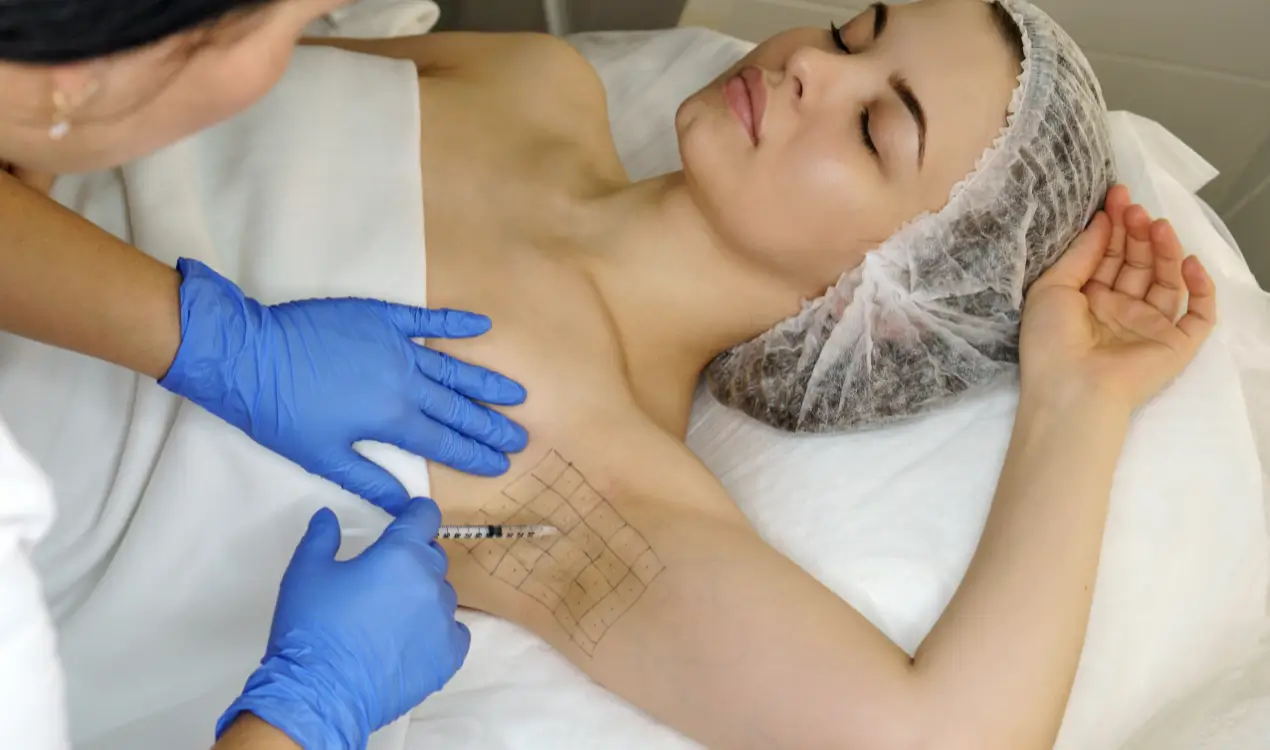
Botulinum toxin type A works on an entirely different principle. Injected directly into the skin of the underarm, it blocks the acetylcholine signal at the nerve–gland junction — the chemical message that tells sweat glands to produce sweat. Without that signal, the glands go quiet. But the glands themselves remain intact. When the Botox wears off, the signal returns, and sweating resumes.
How Effective Is Each Treatment at Reducing Sweating?
In a prospective, randomized, within-patient controlled trial — the most direct head-to-head comparison published — miraDry and Botox achieved statistically equivalent sweat reduction at 12 months: 73% median reduction for miraDry versus 79% for Botox (not statistically significant) (JAAD International, 2024). Both treatments work. The clinical outcomes at one year are essentially identical.
Where miraDry pulls ahead is scope. Because it destroys apocrine glands as well as eccrine glands, it also addresses underarm odor. A prospective study found 93.8% of treated underarms showed good-to-excellent improvement for hyperhidrosis-related odor (Lee SJ et al., Journal of Cosmetic and Laser Therapy, 2013 — preliminary). Botox has no effect on odor glands.
How Long Do Results Last?
This is where the two treatments diverge most sharply. A landmark RCT (Naumann & Lowe, BMJ, 2001) confirmed 95% of patients responded within the first week of Botox treatment — onset is fast. But effects are temporary. A Cochrane systematic review (Cochrane Database, 2022) confirms that Botox for hyperhidrosis requires 2–3 treatments per year to maintain results, with inhibitory effects lasting 6–8 months per session.
Sweat glands destroyed by miraDry’s microwave energy don’t regenerate — the reduction is permanent. Long-term data confirms this holds: a 3-year follow-up found HidroQoL quality-of-life scores dropped from 26 at baseline to 6 at three years — a 77% sustained improvement in quality-of-life burden (Aesthetic Plastic Surgery, 2026).
According to the 2024 JAAD International head-to-head RCT, miraDry and botulinum toxin A achieved equivalent sweat reduction at 12 months — yet 76% of patients preferred miraDry specifically to avoid ongoing re-injection (JAAD International, 2024). That preference gap exists not because miraDry works better short-term, but because it works permanently.
miraDry vs Botox: Full Comparison at a Glance
| Feature | miraDry | Botox |
|---|---|---|
| How it works | Microwave energy permanently destroys sweat + odor glands | Temporarily blocks nerve signals to sweat glands |
| FDA clearance | ✓ Sweating (2011) · Odor (2016) · Hair (2015) | ✓ Axillary sweating (FDA-approved) |
| Sweat reduction (1 yr) | 73% median | 79% median |
| Duration | Permanent | 6–8 months per session |
| Retreatments needed | 1–2 total | 2–3 per year |
| Treats body odor | ✓ Yes | ✗ No |
| Reduces underarm hair | ✓ Yes | ✗ No |
| Usable on palms/feet | ✗ Underarms only | ✓ Yes (off-label) |
| Onset | Days to weeks; full results by 3 months | 95% respond within 1 week |
| Downtime | Same-day return to work | None |
| Compensatory sweating | Not documented in any clinical trial or survey | Not a concern |
| Long-term cost | Lower (one-time) | Higher (recurring) |
Efficacy data: JAAD International, 2024. FDA clearance data: International Hyperhidrosis Society. Duration data: Cochrane 2022.
What Are the Side Effects and Downtime?

miraDry side effects: A 7-site randomized controlled trial (Glaser et al., Dermatologic Surgery, 2012) found that all patients experienced transient swelling, discomfort, and numbness in the treated area. These are expected, temporary effects — not complications. Swelling and soreness resolve within 1–2 weeks; numbness and altered skin sensation resolve within approximately 5 weeks. The study confirmed same-day return to work, with exercise resumable within several days.
What about the concern that miraDry causes sweating to increase elsewhere to compensate? A 2026 JAAD Case Reports analysis addressed this directly, stating that compensatory hyperhidrosis following miraDry “has not been documented in clinical trials, long-term cohort studies, patient surveys, or postmarket surveillance reports” (JAAD Case Reports, 2026). The body’s 2–4 million sweat glands are distributed widely; the underarm glands represent a small fraction of total cooling capacity.
Botox side effects: Injection-site discomfort and occasional bruising are the most common complaints — both resolve within days. There is no systemic downtime. For palmar applications specifically, there is a small risk of temporary muscle weakness from diffusion of the toxin into nearby muscles; this is not a concern for underarm injections.
Who Is miraDry Right For?
miraDry is the right choice when axillary hyperhidrosis is the primary problem and you want to resolve it permanently — not manage it seasonally. The 81.2% patient satisfaction rate found in a 2024 survey of miraDry recipients reflects this: patients report significant improvements in private life, social life, and professional life that persist because the treatment itself persists (GMS Interdisciplinary Plastic and Reconstructive Surgery DGPW, 2024).
miraDry is especially well-suited for patients who:
- Have moderate-to-severe axillary hyperhidrosis confirmed by a provider
- Want a one-time solution — not a maintenance regimen
- Are also bothered by underarm odor or excess hair
- Have already tried clinical-strength antiperspirants with inadequate results
- Are tired of planning life around seasonal Botox appointments
Not Sure Which Is Right for You?
A complimentary consultation at our Carson, CA clinic is the fastest way to know. We’ll review your sweat pattern, areas affected, lifestyle, and goals — and recommend the treatment that fits your specific situation, whether that’s miraDry, Botox, or something else entirely.
Book Your Complimentary ConsultationWho Is Botox Right For?
Botox is the right choice when you want a reversible, proven treatment — either as a starting point before committing to something permanent, or when hyperhidrosis affects areas beyond the underarm where miraDry can’t reach. The 96.1% response rate from the landmark JAMA Dermatology RCT shows Botox works extremely well for axillary hyperhidrosis (JAMA Dermatology, 2003). It’s not a compromise — it’s a legitimate medical treatment with robust evidence.
Botox is especially well-suited for patients who:
- Want to confirm that treating underarm sweat resolves their quality-of-life concerns before committing to a permanent procedure
- Have palmar (hand) or plantar (foot) hyperhidrosis — miraDry is cleared for underarms only; Botox is used off-label for palms and feet with strong clinical evidence
- Have a specific event or season to get through and don’t need permanent management yet
- Have contraindications to the miraDry procedure that a provider has identified
Frequently Asked Questions
Is miraDry better than Botox for underarm sweating?
In a head-to-head RCT, both achieved equivalent sweat reduction at 1 year — 73% vs 79% median reduction, not statistically different (JAAD International, 2024). miraDry’s advantage is permanence: sweat glands destroyed by microwave energy don’t regenerate, while Botox requires re-injection every 6–8 months indefinitely.
How long does Botox for sweating last?
Does miraDry cause compensatory sweating in other areas?
No. A 2026 JAAD Case Reports review states explicitly that compensatory hyperhidrosis following miraDry “has not been documented in clinical trials, long-term cohort studies, patient surveys, or postmarket surveillance reports” (JAAD Case Reports, 2026). The underarm glands represent a small fraction of the body’s 2–4 million total sweat glands.
Can you switch from Botox to miraDry later?
Yes — many patients try Botox first to confirm the underarms are their primary concern, then transition to miraDry for permanent resolution. There is no contraindication to miraDry after prior Botox. Most providers recommend waiting until the prior Botox has fully worn off (typically 6–9 months) before scheduling miraDry.
Is miraDry worth the higher upfront cost compared to Botox?
For patients managing axillary hyperhidrosis long-term, the cumulative cost of 2–3 Botox sessions per year over 3–5 years typically exceeds the one-time miraDry investment. miraDry also addresses odor and hair, which Botox does not. The 3-year follow-up data (Aesthetic Plastic Surgery, 2026) shows sustained results — making miraDry more cost-effective over any meaningful time horizon for most underarm-specific patients.
The Bottom Line
If efficacy at one year is the only metric, miraDry and Botox are equivalent — clinical data confirms this directly. The choice comes down to what happens after year one. Botox keeps working if you keep getting injections. miraDry keeps working without them.
Patients with axillary hyperhidrosis who want to stop managing and start living without it will generally find miraDry the more permanent, cost-effective, and comprehensive solution. Patients who want reversibility, who have non-axillary hyperhidrosis, or who aren’t ready to commit to a permanent procedure will find Botox a well-evidenced, effective alternative.